
Where can I find english-friendly yakitori in Osaka after work?
Find English-friendly yakitori in Osaka after work by targeting Umeda, Namba, and Honmachi, plus booking sites and multilingual menus.
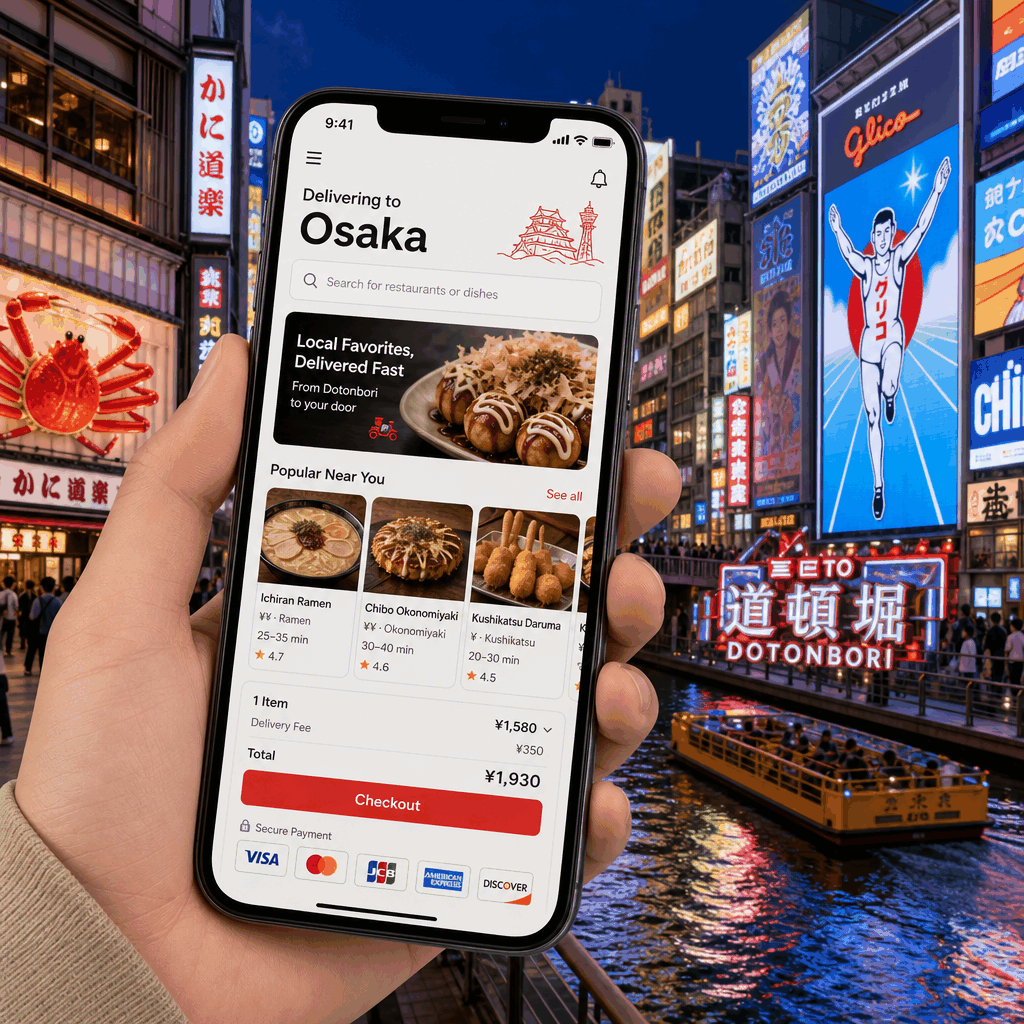
For most people in Osaka, the easiest food delivery apps for English and international cards are Uber Eats and Wolt. Both offer English-language interfaces and support card payments in Japan, which makes them the most practical choices for visitors and residents who do not want to rely on Japanese-only payment methods [1][2].
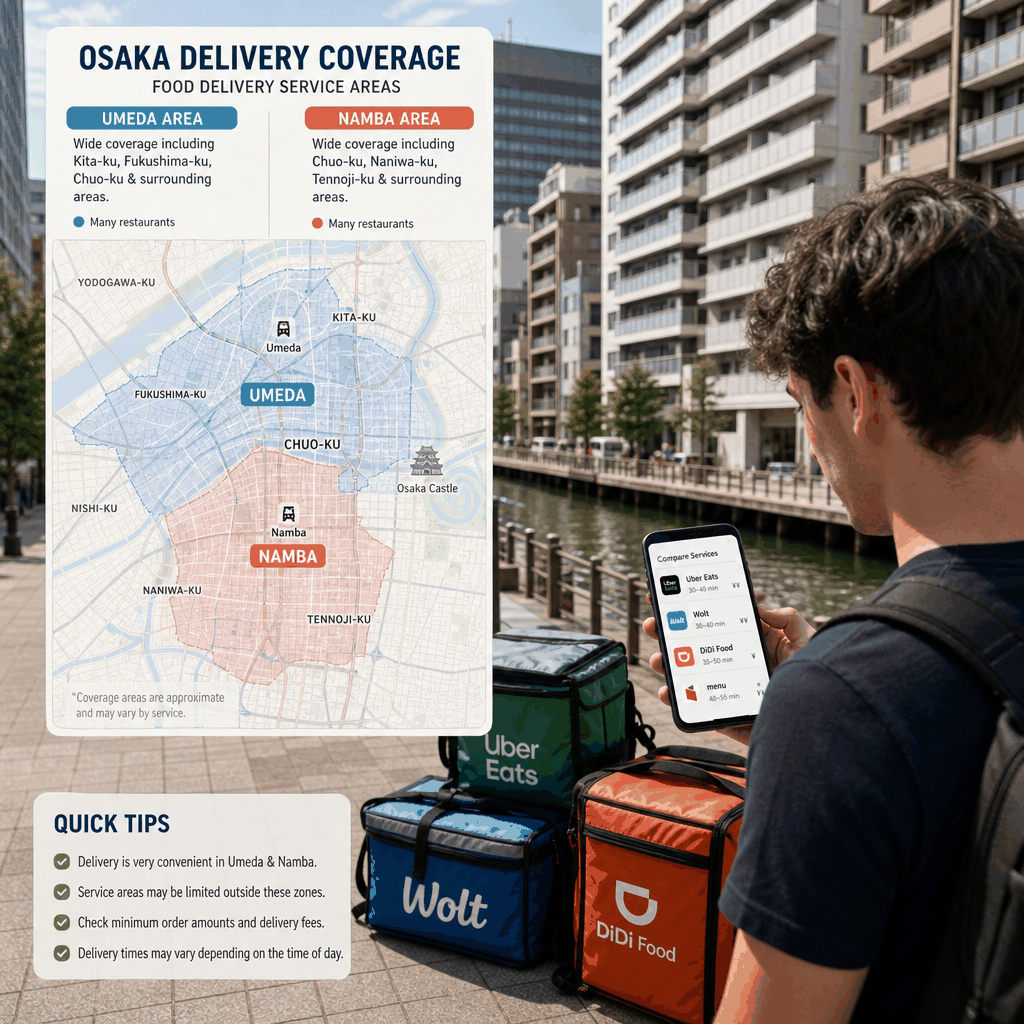
Osaka is one of Japan’s most delivery-friendly cities because demand is concentrated in dense downtown areas, especially Kita, Umeda, and Namba [4]. That matters because app availability is only one part of the equation: even if an app works in English, your order still depends on whether the restaurant delivers to your exact address and whether the courier can reach your building. In practice, central wards are the safest bet for fast, reliable service.
For English users, the key question is not just “Which app exists?” but “Which app can I actually sign up for, pay with, and use without Japanese-language hurdles?” In Osaka, Uber Eats and Wolt are usually the first apps to test, while menu can be useful for Japan-wide coverage but is generally less convenient in English [1][2][3].
Uber Eats Japan says it accepts credit cards as a payment method in Japan, and its Japanese service is available through the app and website [1][5]. For English users, that combination is important because you can browse the app in English and pay by card without needing a Japanese cash setup. In Osaka, Uber Eats is often the easiest first option because many restaurants in central areas are already listed.
Wolt Japan also provides an English help center and supports card payments, including major credit cards used in Japan [2]. If you are comparing apps for a short trip, Wolt is especially appealing because the English support is straightforward and the checkout flow is designed to be app-based rather than cash-based. That said, restaurant selection can vary by neighborhood and time of day, so it is worth checking both Uber Eats and Wolt before ordering.
menu is a major Japan-based delivery platform with broad domestic coverage, but its site and workflow are more Japan-centric than Uber Eats or Wolt [3]. For English-speaking users, that usually means it is worth having as a backup rather than your primary app unless you are comfortable navigating Japanese instructions or you already have a Japanese-language account setup.
Uber Eats and Wolt are the strongest choices if you want a mostly English experience. Uber Eats Japan has English support in its app ecosystem, and Wolt Japan maintains English-language help pages and app support [1][2]. That does not mean every restaurant menu or courier note will be translated perfectly, but the core flow—search, cart, payment, delivery tracking—is much easier than on a Japan-only platform.
menu is more variable. Some parts of the service may be understandable if you are used to Japanese apps, but it is not the most beginner-friendly option for English-only users [3]. If your goal is speed and low friction, start with Uber Eats or Wolt first.
Both Uber Eats and Wolt support card-based checkout in Japan, but “supports cards” does not always mean “every international card will succeed.” A common reason for failure is the card issuer blocking online or overseas transactions, even when the delivery app itself accepts credit cards [1][2]. If your card is declined, try another major Visa, Mastercard, or JCB-enabled card if you have one, and check whether your bank requires overseas purchase approval.
It is also wise to confirm your card before you need it. App language settings, payment availability, and verification prompts can change, and the safest approach is to test your preferred app while you still have time to switch services if needed [1][2]. If you are in Osaka for only a few days, a failed first order can eat up valuable time.
Another practical issue is address formatting. Some buildings in Osaka are easy for couriers to find, but others require precise apartment names, floor numbers, and delivery notes. Even when the app is in English, courier communication may still depend on the exact address details you enter.
Coverage is strongest in Osaka’s dense central districts, where restaurant concentration and courier density are highest. The Osaka Convention & Tourism Bureau highlights central areas such as Kita, Umeda, and Namba as major city zones for visitors [4], and those are also the places where delivery apps tend to work most smoothly. If you are staying near Osaka Station, Umeda, Shinsaibashi, or Namba, your odds of getting a broad selection are usually best.
Outside the center, delivery options may still exist, but selection can shrink quickly depending on the exact ward and distance from busy commercial streets. That is why it helps to check both the app map and the estimated delivery time before building your order around a specific restaurant. Osaka is well covered overall, but it is not uniform.
For example, a hotel near Umeda may show multiple pizza, curry, and convenience-style meal options, while a guesthouse farther from the core may only show a handful of listings. If you are staying in a less central area, do not assume the same app experience you would have in Namba or Kita.
If this is your first time ordering food delivery in Japan, keep the setup simple. Use the app in English, add your card before the meal rush, and save your building details carefully. That reduces the chance of a payment delay or a courier misunderstanding.
If you are staying in Osaka for a longer period, it can also be worth adding menu as a backup once you are comfortable with the Japanese interface [3]. That gives you more restaurant options, especially when you want something specific that is not listed on the English-first apps.
For a short stay in Osaka, Uber Eats is usually the simplest all-around choice because of its English interface and card acceptance in Japan [1][5]. Wolt is the best backup if Uber Eats has limited availability at your location or the restaurant you want is listed only on Wolt [2]. If you are staying in a central Osaka neighborhood like Umeda or Namba, those two apps are usually enough to cover most situations [4].
For a longer stay, it makes sense to keep all three apps installed. Start with Uber Eats and Wolt for the smoothest English experience, then add menu if you want broader Japan-specific reach [1][2][3]. The most reliable strategy in Osaka is not choosing one app forever, but checking which service has the right restaurant, the right delivery area, and a card checkout that works that day.
In other words, the best Osaka food delivery app for English users is the one that combines English support, international card acceptance, and coverage in your neighborhood. In most cases, that means Uber Eats first, Wolt second, and menu as a backup.
CallButler is a multilingual concierge service that handles research, coordination, and bookings so you do not have to navigate language barriers or unfamiliar systems alone. If you need help related to Which Osaka food delivery apps accept international cards and English? or the tasks around it, our team can step in to manage the details and keep things moving smoothly.
Find English-friendly yakitori in Osaka after work by targeting Umeda, Namba, and Honmachi, plus booking sites and multilingual menus.

Looking for halal ramen in Kyoto after 10 p.m.? Here’s where to check, which areas are most practical, and how to verify hours and halal status.
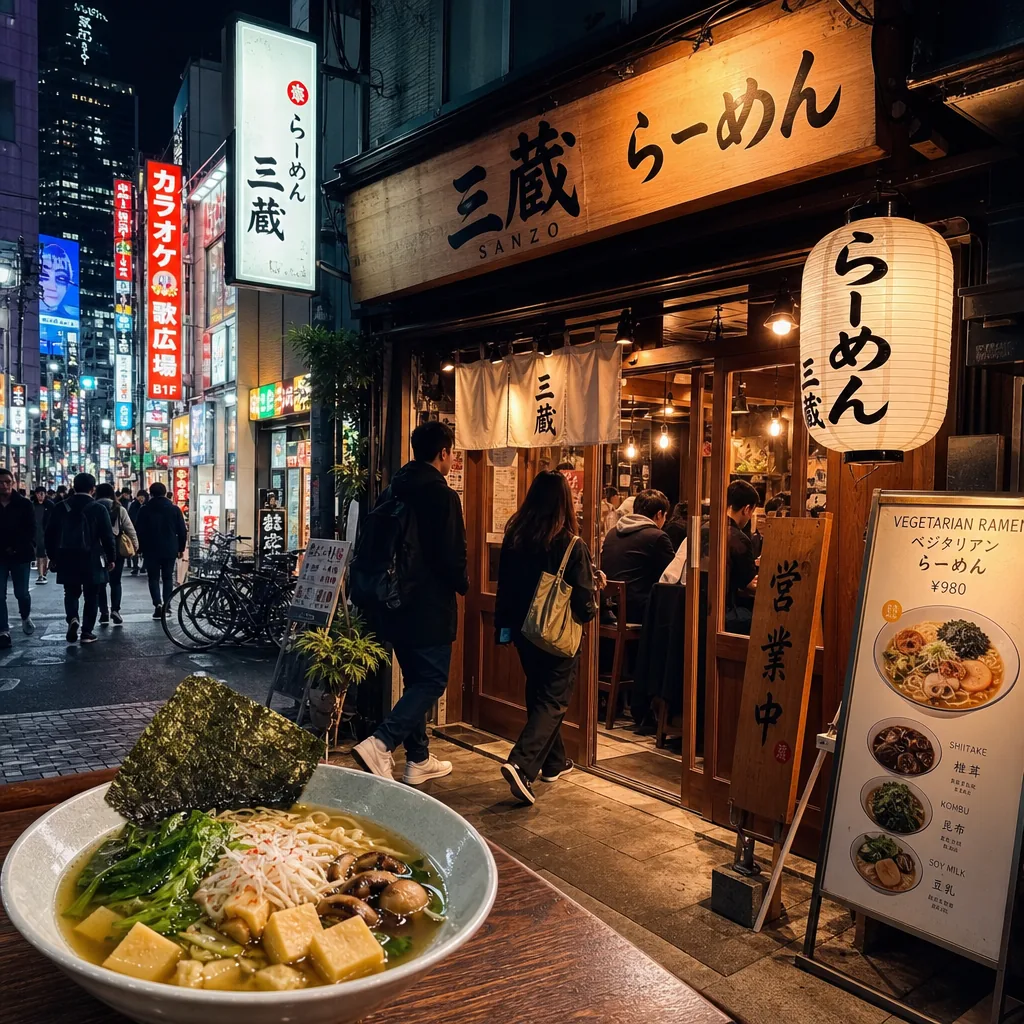
Find late-night vegetarian ramen in Tokyo by focusing on Shibuya, Shinjuku, and Roppongi, then verify broth, hours, and vegan menu details.